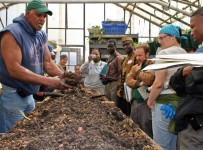
…will be joining me in conversation on April 7th at Princeton University and on April 8th at WNYC’s Greene Space in New York (along with one or two other exciting participants to be announced shortly) for a conversation on food and cities, to coincide with the release of the expanded edition of the Edible Estates book – for which Will has contributed a wonderful new manifesto and call-to-arms for a food revolution, here is a short excerpt/preview:
My Edible Estates, therefore, are schoolyards and vacant lots, abandoned tracts of brownfield land, any plot of any size and condition that can be used to grow food right in the middle of the community that needs it. It is a daunting prospect, to say the least, yet I am optimistic that I will see examples created in which these food deserts will be turned into oases where, again, at least 10 percent of the community’s food needs will be supplied. I am optimistic about this not because I believe so strongly in my own abilities, but rather because, to my surprise, the people in those communities have been asking me for this opportunity since the day my journey as a farmer began.
When I was born, my father was a sharecropper, but he wanted to free himself and his large family from that particular form of bondage. He saved enough to buy a small farm in Maryland. His market was the Washington, D.C., area, and it became focused on the large population of Southern blacks who were moving north and settling, people who were used to having fresh produce in their diets but who expected it to be affordable.
I saw firsthand, by working with my hands, the amazing amount of produce that could be grown on just eight acres if the most intensive methods were employed. Later, when I was living in Belgium and playing basketball, I got to know a number of farmers who similarly grew astonishing quantities of food on very small acreages by constantly enriching the soil with organic matter.
Eventually I was drawn back to farming, and in 1993 I bought a small roadside market and garden center on Milwaukee’s impoverished north side. The stand was intended as a market for my own produce but also, and I hoped more importantly, as a place to offer fresher, more healthful food to an undernourished community. As it happened, that tiny two-acre plot, with its miniature storefront and handful of timeworn greenhouses, was the last tract of land within the city of Milwaukee that was still zoned for agriculture. It was almost as if some city planner had forgotten something—or that fate had somehow reserved the place for me. At any rate, I realized that I could do a good deal more at what I was then calling “Will’s Roadside Produce Stand” than just sell vegetables from my farm. For one thing, I could grow more vegetables right there on site, and I proceeded to clear a half-acre bed, improve its soil, and plant it with an assortment of veggies.